Most team-building activities have a reputation problem, and it’s one they’ve earned over years of trust falls, forced icebreakers, and a facilitator with a clipboard trying to manufacture connections out of thin air. None of it actually gets people talking across departments, and most employees can tell within the first ten minutes whether an activity is going to be worth their afternoon. Water Tag takes a different approach entirely, mixing laser tag equipment with a water element into a genuinely fun outdoor entertainment experience rather than something structured to merely look like engagement on a company calendar. The format leans into play instead of performance, which changes how people actually behave once the activity starts. It’s competitive, sure, but loose enough that nobody’s worried about looking foolish in front of coworkers. For teams tired of activities everyone quietly dreads before they’ve even arrived, that distinction matters more than any agenda slide or icebreaker script ever could.
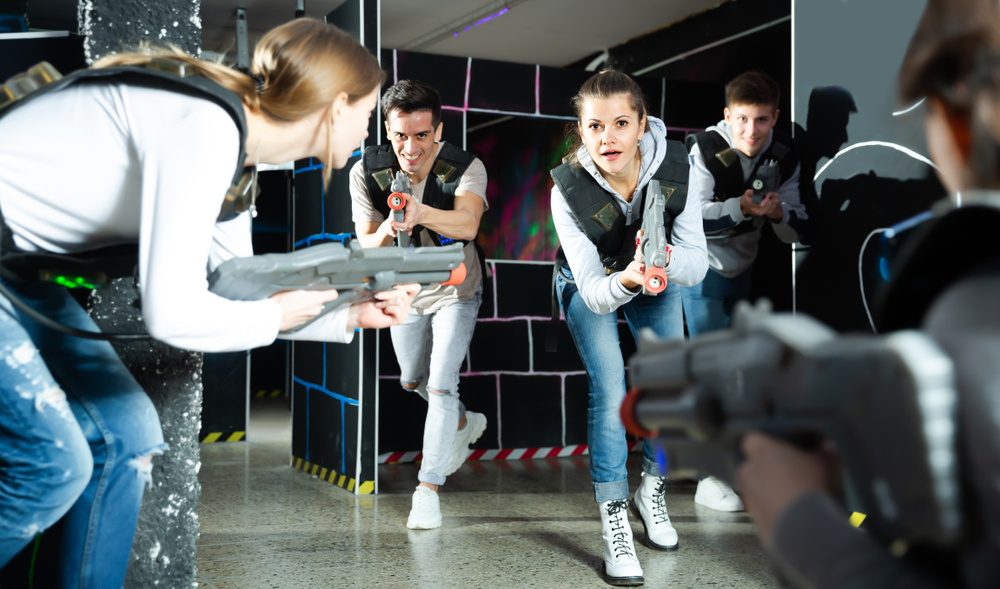
The usual failure mode is pretty predictable. Either the activity’s too passive to get anyone actually engaged, or it’s competitive in a way that leaves quieter people standing on the sidelines. Getting that balance right is harder than it sounds; something built for a group of six rarely holds up once you’re running it for sixty.
Scale is where a lot of large group activities fall apart, specifically. A standard laser tag arena has a hard capacity limit. Outdoor alternatives get rained out or need a logistics team just to set up. There’s also the time factor of booking a venue, coordinating transportation, and working around a facility’s own schedule that eats into a day that was supposed to be about the team, not the planning behind it. Water Tag sidesteps all of that by bringing the equipment to wherever the group already is instead of asking the group to come to it.
The hybrid format is really the whole idea. Laser tag equipment plus water changes the physical experience enough that it stops feeling like a forced competitive exercise and starts feeling like something people actually want to do. There’s a reason water-based games have stayed popular at every age level for decades. The unpredictability and the sensory element pull people in without them having to try. Layer laser tag mechanics on top of that, and you get something with real strategic depth alongside the fun.
And because it’s delivered as fully mobile outdoor entertainment, a company isn’t boxed in by one venue’s capacity; the event scales to the group, not the other way around. That flexibility also means it can slot into an existing company event, like a retreat or an offsite, rather than requiring an entirely separate outing built around it.
Traditional laser tag venues work fine for small groups in a fixed space, but they weren’t built for large group activities running into the hundreds. Generic outdoor vendors solve the space problem but usually swap in lower-energy formats, rope courses, and trivia that don’t get people moving the same way. Water Tag sits in the middle: high-energy and scalable, without the venue cap of laser tag or the flat energy of a typical outdoor option.
| Feature | Water Tag | Standard Laser Tag Venues | Generic Outdoor Vendors |
| Group size | Scales up easily | Capped by the venue | All over the place |
| Equipment | Laser tag + water hybrid | Laser tag only | Usually none |
| Delivery | Comes to you | Fixed location | Sometimes on-site |
| Energy level | High, inclusive | Competitive, indoor | Often flat |
People at different fitness or confidence levels can still join in without feeling sidelined; the format keeps things light rather than purely competitive. There’s no venue to book or capacity to negotiate, since the setup travels with the event, which also cuts down significantly on planning time for whoever’s organizing it. And it scales the same whether you’ve got 20 people or 200, instead of needing a different vendor once the group gets big enough that a standard laser tag arena can’t hold everyone at once.
There’s a practical cost angle here too. Booking a fixed venue often means paying for the space regardless of how many people show up, plus transportation for the whole group. An on-site model removes that overhead entirely, since the only variable is the group itself.
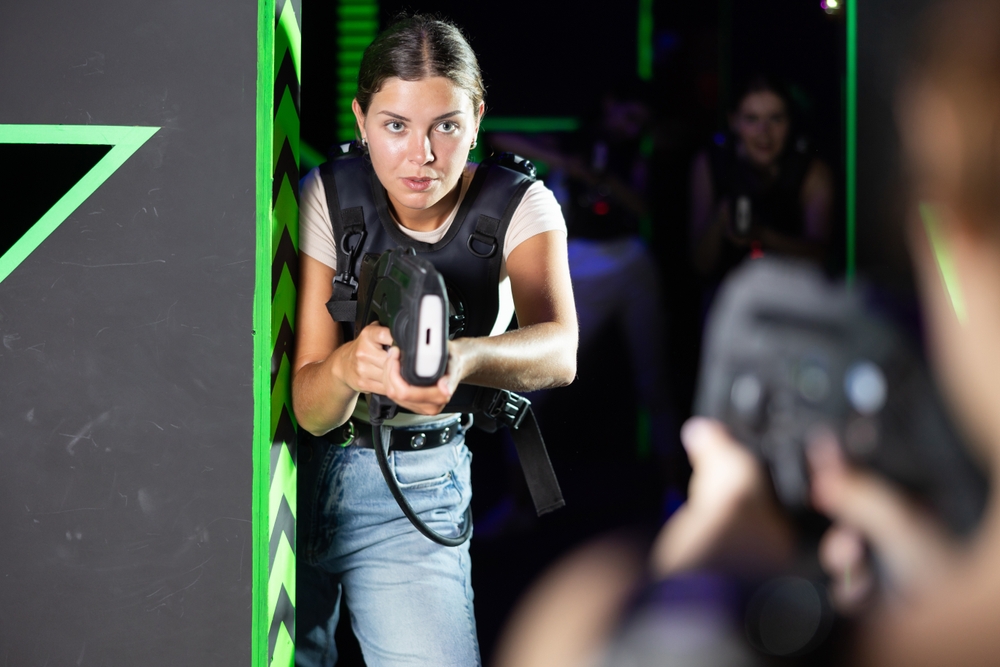
A company running its annual retreat can swap out the usual outdoor picnic for something that actually gets people moving and talking across teams instead of clustering into the same small groups they already know. A larger company running a multi-team offsite can scale the same format up without splitting into smaller groups that never interact with each other. Planners organizing large group activities for a conference can skip transporting attendees somewhere else entirely, since the whole thing sets up wherever the event already is, a hotel lawn, a company campus, or a rented outdoor space.
It also works well for companies that have already tried the standard rotation of team-building activities and found the group has aged out of trust falls and trivia nights. Something physical, a little chaotic, and genuinely fun tends to land better with a team that’s sat through one too many forced icebreakers.
1.How’s this different from a regular laser tag?
It adds water into the mix alongside the standard laser tag mechanics, which makes the whole thing feel more like play and less like a straight competition.
2.Does it actually work for big corporate groups?
Yes, that’s really the point of the on-site model. It’s built to scale past what a fixed laser tag venue can handle.
3.Can this run as an outdoor event?
Yes, it’s designed specifically as outdoor entertainment that doesn’t need a dedicated indoor space.
Team building doesn’t have to mean another awkward afternoon everyone forgets by Monday. The activities that actually work are the ones people get genuinely invested in without being told to, and that’s the gap Water Tag is built to fill, combining laser tag equipment with water into something that scales to any group size without losing the energy that makes it worth doing in the first place. For companies looking at team-building activities and wanting something people actually talk about afterward, that’s the difference worth paying attention to.
Planning team building activities that actually work is harder than it sounds. Most people have sat through the awkward trust falls, the forced icebreakers, the lunchroom trivia rounds that barely get anyone off their phones. The truth is, people remember experiences that move them, challenge them, and get them genuinely laughing with the people beside them. That is exactly the gap that Watertag fills, and it fills it better than anything else on the market right now.

There is a big difference between an activity your team tolerates and one they talk about for weeks. Real engagement happens when people are physically involved, the stakes feel real even if they are low, and every single person regardless of age or fitness level has a role to play.
Water tag hits every one of those marks. It is a structured, outdoor battle game where players wear sensor vests and use water launchers to compete across a purpose-built field of inflatable barrels. The barrels are not decorated. They serve as refill stations, defensive cover, scoring targets, and team bases all at once. That field design is what turns a simple water fight into a genuinely strategic game that requires communication, movement, and quick decision-making under pressure.
For companies, camps, resorts, and event operators looking for large group activities that scale without chaos, this format solves the two biggest problems in one shot: engagement and manageability.
Watertag, operating under the Falcon brand, was built specifically for commercial operators. This is not a consumer product that someone decided to rent out. Every component, from the vest design to the inflatable barrel system, was engineered for daily use with large groups and minimal staff overhead.
The anti-cheat vest design alone sets Watertag apart. Water enters through intake slits and collects in a lower chamber with a visible gauge. Draining it during gameplay would require an awkward, sustained tipping motion that is simply not practical in an active round. That means rounds stay fair, disputes stay minimal, and your staff spends less time mediating and more time running sessions.
Setup takes around 25 minutes. Pack-down takes about 10. The entire kit fits in a standard commercial vehicle, making it genuinely portable in a way that fixed installations or heavy laser tag equipment rigs simply are not. For operators who serve schools, corporate clients, summer camps, and resort guests, that mobility is a revenue multiplier.
Watertag also offers six distinct game modes including Team Deathmatch, Capture the Flag, Battle Royale, and Domination, giving operators enough variety to keep repeat guests fully engaged across multiple visits.
| Feature | Watertag (Falcon) | Traditional Laser Tag |
| Setup Time | 25 minutes | 1 to 3 hours |
| Portability | Fully mobile, fits a van | Fixed venue required |
| Player Capacity | 30 to 100 players per package | Usually limited by arena size |
| Age Suitability | Ages 6 and above | Varies, often indoor only |
| Staff Required | 1 manager plus 2 assistants | Larger venue staff |
| Warranty | 2 years | Typically 1 year or less |
| Game Variety | 6 structured modes | Limited by software |
| Outdoor Use | Fully designed for outdoor play | Rarely suitable outdoors |

Corporate events are one of the strongest fits. Groups that struggle to connect in meeting rooms open up completely once they are competing side by side on a battlefield. Watertag sessions give every department, every seniority level, and every personality type a common experience that flattens hierarchy in the best way possible.
Summer camps have seen some of the most enthusiastic adoption. Camp directors report that Water Tag quickly became the most requested activity of the season, appealing to children as young as seven and staff members in equal measure. On a hot afternoon, nothing else comes close.
Resorts and rental operators benefit from the recurring booking model. Because the game is genuinely replayable with six different formats, guests return for follow-up sessions rather than looking for something new. That repeat booking behavior directly improves revenue per customer across the season.
The best team building activities share one quality: people do not realize they are participating in something planned. They are just having a genuinely good time. Watertag creates exactly that experience, and it does it at a commercial scale that most outdoor entertainment options cannot match. Whether you are running corporate events, summer programs, or resort programming, Watertag gives your groups a reason to show up, stay engaged, and come back again.
The game is designed for ages 6 and above. The structured rules and physical format work across a wide range of ages without modification.
2. How many staff members does an operator need to run a session?
A single game manager and two assistants can comfortably handle up to 150 players per hour.
3. Is the water tag suitable as a corporate team-building activity?
It is one of the strongest options available. The game builds communication, strategy, and shared experience in a way that indoor activities rarely achieve.