The best team building activities achieve more than merely gathering the participants together. It enriches the surrounding by promoting communication, decision-making, problem-solving, and collaboration beyond the usual office environment.
This is where the right activity is needed. Though it may seem appealing, an activity may fail to be a success if it involves applauding and cheering from a group of 50 individuals. An interesting game may prove to be easily executed, but a similar result may not be transferred to the passive participants. Event organizers should always aim at an adequate level of activity regarding involvement, organization, activity level, and simplicity of execution.
Moving an event outdoors changes how participants behave, removing some of the ritualistic aspects of work engagement. So, while participants enjoy several benefits such as more freedom of movement, fewer signals related to traditional office work, and other advantages, they also benefit from an opportunity to engage in outdoor activities while building new relationships and working together.
Outdoor entertainment is also advantageous in that it allows event organizers to create something, rather than hold a simple meeting with some activities.
Outdoor activities can also be organized using formats that are normally impossible to recreate indoors. For example, team races, overcoming obstacles, field fun, and competitions on water create memories that participants will share long after the event.
As for the achievements in organizing outdoor activities, the organizers should pay special attention to the venue. They should make sure that water is available and assess the weather, location, equipment storage, changing rooms, as well as emergency procedures.
Large group activities such as laser tag equipment are well-known options for team events because they automatically provide teams, goals, and competition. However, regular laser tag usually requires special indoor or purpose-built sites depending on the format being played.
Water Tag provides a different approach, being an outdoor water game incorporating responsive vests, water launchers, and inflatable barrels used to organize play. Falcon Water Tag has placed this attraction to be used by camps, resorts, and businesses that can have fun playing structured games with specific equipment.
Therefore, your choice needs to be based on the experience you want to get rather than on which activity is to be considered better.
| Consideration | Water Tag | Traditional Laser Tag |
| Environment | Outdoor, water-based | Often indoor or controlled environments |
| Physical experience | Active and water-based | Active, generally dry |
| Equipment | Water launchers, vests, field barriers | Tagging devices, sensors, related equipment |
| Atmosphere | Casual, energetic, cooling | Tactical, competitive |
| Venue requirement | Outdoor space + water access | Suitable laser-tag environment |
| Best fit | Camps, resorts, outdoor events | Entertainment centers, indoor events |
Large-scale gatherings pose a challenge that is not easy to see: quantity.
Each activity must be interesting and comprehensible even with the presence of a lot of players. The Water Tag system of Falcon is built using various systems of rules and several scenarios. For instance: Team Deathmatch, Capture the Flag, Battle Royale, King of the Hill, Domination, and Relay Run.
This variety of formats gives them a lot of options. A purely competitive group may want a game with some goals, while a mixed group can find simpler options more useful.
According to Falcon, their system is able to serve as many as 150 participants a turn with a relatively small crew. The installation of the system takes around 25 minutes and the dismantling takes just 10 minutes.
What one can take from this case is the importance of the throughput measure in regard to large group activities.
All types of team-building activities do not create an atmosphere where people are engaged in the process. Therefore, sometimes team building activities serve a different purpose – creating an opportunity for co-workers to get to know one another without considering their boss, department, or post. That is why we can say that it is necessary to choose the right activity depending on the expected outcome.
For example, if a task is to improve communication skills, we need to select those games that require teamwork. In case energy and social interactions are needed, outdoor games should be preferred. In case of the necessity to involve a large number of people in the activity, there should be chosen such games where the number of participants is not a problem because there will be many rounds.
Thus, the working model of WaterTag operates according to this principle in order to provide ready-to-use equipment, team training sessions, playing games, and its projects starting from providing services for 30 players and being upgradable as long as possible.
The most suitable activities are those that have rules that are easy to understand, have rounds that are either short or can be repeated, involve physical activity by participants, and demand a fair amount of staff to run the event. Large group activities such as Outdoor Water Tag have been found to be especially useful if the venue has an appropriate environment.
Indeed. Water Tag is designed to create a competitive environment amongst teams, which promotes collaboration, movement, and decision-making. Falcon deploys its equipment at corporate and commercial events.
Of course. Falcon’s equipment is specially manufactured for commercial and continuous use in a variety of game modes with customizable packages for operators.
Thereisn’t a clear winner between the options mentioned above. Both options can have their advantages for indoor or tactical events when water-based activities are simply not an option. The choice will depend on the venue, size of the group, weather conditions, and purposes of the event.
When making a choice, the number of participants that can be involved and handled, number of staff members, certain requirements of the venue, setup time, safety requirements, accessibility, and downtime should be taken into account.
If you’re comparing the different commercial water park equipment suppliers, you will get easily sidetracked by their equipment catalogs and neglect the operational aspects of realizing whether an attraction can run its operation continuously.
However, when you are planning corporate outings and similar events, a more important question would be not “What are the possible purchases?” but rather “What equipment are our employees able to operate on a daily basis?” which is very important when selecting suitable commercial water park equipment, especially in cases of mobile attractions and attractions for big groups.
An equipment supplier should offer more than just cool looking equipment in photographs.
Before you make any comparisons among suppliers, consider the following points:
| Evaluation factor | What to check | Why it matters |
| Durability | Materials, stitching, seams, components | Reduces interruptions during repeated use |
| Capacity | Players per session and expansion options | Determines potential throughput |
| Setup | Assembly and pack-down requirements | Affects staffing and operating time |
| Mobility | Transport and storage requirements | Important for camps and traveling events |
| Training | Staff guidance and operating resources | Reduces the learning curve |
| Support | Warranty and post-purchase assistance | Protects the investment |
| Scalability | Ability to add equipment later | Allows capacity to grow with demand |
What has been neglected is the operational friction. Equipment that involves complicated handling, requires extensive setup, or needs special maintenance can generate a large amount of dollars.
One of the most common purchasing errors is assuming that any product labeled as “water equipment” can be used commercially.
For commercial usage, it is important that the equipment can withstand constant handling, multiple setups and takedowns, exposure to the rain, and usage by big groups of people throughout the day.
Falcon Water Tag focuses on making its equipment perfect for everyday group use and offers commercial packages that can accommodate different capacities of players.
For the buyers, this means looking beyond the label.
The suppliers should be asked the following:
This is especially crucial for commercial water tag equipment since it needs to be handled all the time, not simply placed into position and left there.
It is not mandatory for each business offering water attractions to have a standard fixed water attraction installation.
A summer camp needs easy-to-set outdoor camp games which can operate seasonally, while a resort operator can want an attraction which will add one more paid activity to its offering. An event company is searching for memorabilia which should be transported from one venue to the other, while a business focusing on company retreat activities will choose the fast installation process alongside user participation as compared to a permanent installation.
That is why mobile water attractions should be viewed together with the conventional water-park ones.
For instance, Falcon Water Tag sees its water attraction as mobile and operating wherever there is water to work. The barrels are collapsible so that the transport is made easier. In addition to that, the package is expandable so that new vests and launchers can be added to provide the needed capacity.
The practical lesson is that the operating model should be selected first and the equipment second.
Operators who are looking into commercial water tag equipment need to think about throughput and manpower as thoroughly as they think about the product specifications themselves. Falcon claims that its system can accommodate up to 150 guests per hour, while requiring only limited staff for its operation, and only taking about 25 minutes to set up and roughly 10 minutes to pack up after an event. The figures given by the manufacturers should be taken into account when evaluating the suitability of the equipment for prospective buyers.
The benefit of having organized attractions is that the employees do not hand out equipment and hope the players will self-organize. The scheme establishes the competitive rules, layout of the field, and nature of specific game formats.
It is important on the commercial basis as a predictable process makes it easier to plan for events and train new employees.
A relationship between a supplier and an operator becomes almost as critical as the equipment itself.
A good supplier has to assist in answering queries on installation, games design, manpower, repair, and development. Falcon has been giving support and training to operators, such as advice on organizing the layout of the areas, design of games, manpower, etc.
This advice can be especially useful when the company is presenting a water park for the first time.
Thus, a proper checklist for purchasing should consist of:
The specialization of WaterTag in Falcon Water Tag system is determined upon operators rather than amounts of customers. Its options contain commercial systems, organized games, training materials and possible capacity of participants.
That means that the system can be used by the companies that are searching for something more than fixed installations.
Whether your project concerns company retreat activities, summer season events, hotels, camps or event business, it is important to take into consideration that the equipment must correspond to the operational reality of the business.
So, the best water park equipment suppliers become not those who have the biggest catalogs but those who know how their systems will be delivered, installed, run and maintained.
1.What should I look for in water park equipment suppliers?
When choosing commercial water park equipment, pay attention to durability, capacity, installation time, transportability of the equipment, warranty service, replacement assistance, personnel training, and potential for equipment expansion in future.
2.What is commercial water park equipment?
Commercial water park equipment can be used repeatedly at professional facilities rather than on a casual basis. Effective buyers will focus on the quality of the construction and operational requirements instead of relying on the word “commercial” only.
3.Is commercial water tag equipment suitable for camps?
Yes. Commercial water tags can be especially effective for structures that need planned official outdoor activities. A proper selection should include considering the equipment and capacities required for participants.
4.Can water attractions work for company retreat activities?
Yes. Water-based outdoor games can be very attractive for upper management retreats. The choice of an outdoor game requires proper analysis of statistics of guests joining, and requirements of the place to organize the game.
Operators researching water sports tag are usually past the “is this fun” question when they’ve seen the videos, they know groups love it. What they actually need is harder to find: how this category fits alongside existing attractions, what equipment quality actually looks like, and which suppliers understand commercial use versus backyard play.
That’s the gap most articles on this topic don’t close. Below is what actually matters once you’re deciding whether to add it, and how to source it without regretting the purchase six months in.
Water sports tag sits in an unusual spot: it’s structured enough to run like an organized game, but physical and messy enough to feel like a genuine outdoor attraction rather than a supervised activity. That combination is exactly why camps, resorts, and event operators add it; it fills the gap between passive water play (splash pads, pools) and higher-liability activities that need lifeguards or specialized certification.
A detail overlooked by operators new to the category: because it’s rules-based rather than open water play, it typically doesn’t carry the same lifeguard requirement as pool attractions. That changes the staffing math considerably compared to almost anything else involving water on-site.
Anyone researching this space runs into two different equipment families fairly quickly, and the difference matters more than most product pages explain.
A water jelly gun is a handheld blaster loaded with soft, biodegradable water-absorbing gel beads closer to a paintball-style mechanic than a soaking. It’s low-cost to source and easy to demo, which is why it shows up often in smaller pop-up activations. But it comes with real trade-offs: gel bead cleanup on-site, consumable resupply costs per session, and less structured gameplay, which makes it harder to run as a repeatable, ticketed attraction at scale.
Vest-and-launcher water tag systems work differently with reusable water reservoirs, structured hit-registration, and no consumables to restock between sessions. For operators running back-to-back groups daily, that difference in per-session overhead adds up fast. It’s worth mapping out expected session volume before choosing between the two, because the economics diverge quickly once you’re running more than a handful of sessions a week.
The term commercial water park equipment gets used loosely across supplier catalogs, and it causes real confusion during purchasing. Consumer-grade gear is built to survive a weekend; commercial gear has to survive daily setup, teardown, direct sun exposure, and repeated handling by staff who are focused on running the game, not babying the equipment.
In practice, the components that separate genuinely commercial-grade gear from relabeled consumer products are:
A warranty length is often the fastest signal of how confident a manufacturer actually is in their own build quality equipment rated for daily commercial use should be backed accordingly, not covered under the same terms as a backyard toy.
Not all water park equipment suppliers operate the same way, and the differences show up long after the purchase, not during it. A few questions worth asking before signing anything:
| Evaluation Point | What to Ask | Why It Matters |
| Warranty terms | Length and what’s actually covered | Signals real confidence in commercial durability |
| Operational support | Do they provide staffing/setup guidance? | Determines how fast you can launch and run smoothly |
| Scalability | Can you add capacity without replacing the system? | Avoids a full rebuild once demand grows |
| Game format variety | How many structured scenarios are included? | Keeps repeat visitors engaged over a season |
| Lead time and logistics | Realistic delivery windows, not best-case | Prevents missed launch dates |
Operators frequently underweight the operational support question. Equipment that arrives without field layout guidance, staffing recommendations, or training resources puts the entire launch burden on internal staff who may have never run this kind of attraction before.
The most frequent misstep among first-time buyers comparing water park suppliers is anchoring the decision on price per unit rather than cost per season of reliable use. A cheaper package that needs partial replacement mid-season, or that lacks the operational guidance to run efficiently, often ends up more expensive than a commercial-grade system with a longer warranty and built-in support.
The more useful comparison is the total cost of running a season: equipment durability, staffing efficiency, expected downtime for repairs, and how easily the system scales if attendance exceeds projections.
Water sports tag earns its place in a recreation lineup because it’s genuinely differentiated, physical, structured, and appealing across a wide age range without the liability overhead of open water attractions. The operators who get the most value from it are the ones who source equipment built for daily commercial use, not repurposed consumer gear, and who choose suppliers offering real operational support rather than just a box of vests. Falcon Water Tag’s package structure scalable from smaller starter setups to full commercial systems, backed by a two-year warranty reflects that same standard.
1. What does “water sports tag” mean?
It is an outdoor game with set rules. Players wear water vest units and use launchers to tag other players. Most events are run like laser tag, but the main difference is water instead of light or other projectiles.
2. Is a water jelly gun the same as water tag gear?
A water jelly gun is a hand-held toy blaster that fires gel beads. Most of them are made for small events where setup time is short. Water tag games usually use reusable vests and launchers made to handle many rounds. They are built for longer commercial sessions and can be used for repeated play.
3. What should I check when buying commercial water park equipment?
Look closely at the seam material and the barrel build. Also examine the valves. These parts are the ones that tend to break first during heavy daily use. Warranty length matters too. It often shows how much confidence the maker has in the product.
Most people researching commercial water tag equipment aren’t looking for a definition of the game. They already know what a water tag is: vests, launchers, inflatable barriers, a soaked and laughing crowd. What they’re trying to figure out is something harder to Google: which equipment will actually survive a summer of back-to-back groups, and which will quietly fall apart by August.
That’s the gap this article fills. Not “what is water tag,” but what operators discover once the gear is sitting in a field and 40 kids are lined up waiting to play.
Consumer-grade water toys are built to survive a weekend at home. Commercial equipment has to survive dozens of sessions a week, in direct sun, dragged across grass and gravel, packed wet into a trailer, and unpacked the next morning to do it again.
The practical difference shows up in a few specific places:
A mistake newer operators make is buying based on package price per player rather than expected lifespan per unit. A slightly higher upfront cost on gear rated for continuous commercial use almost always beats replacing consumer-grade vests twice in one season.
On paper, water tag looks simple: unpack, inflate, play. In practice, the setup speed and staffing needs are what determine whether the attraction is profitable at the volume operators need.
A well-designed commercial water tag equipment package should realistically go from truck to playable field in around 25 minutes, and pack down in about 10, without requiring a trailer or specialized crew. That matters because most camps, resorts, and event operators are not staffing a dedicated setup team; they’re pulling from existing recreation staff who also need to run the game itself.
One detail overlooked by first-time buyers: a lean staffing model (one game manager plus two assistants) can run well over 100 players per hour when the field layout and rules are structured properly. Equipment that requires more hands just to operate erodes the margin before a single session is booked.
“Kit” and “set” get used loosely across the industry, which causes confusion during purchasing. In practice, a starter water tag kit usually covers a smaller player count and a narrower range of game formats, while a full water tag set includes multiple barrel types, flag stations, and enough vests and launchers to run structured, multi-team scenarios.
| Consideration | Starter Water Tag Kit | Full Commercial Water Tag Set |
| Typical player capacity | 30 players | 60–100+ players |
| Game format variety | Limited (1–2 formats) | Multiple structured scenarios |
| Best fit | New operators testing demand | Camps, resorts, high-volume events |
| Expansion path | Add vests/launchers later | Already built for scale |
| Staffing needs | Small crew | Same small crew, higher throughput |
The scalability question is worth planning for before the first purchase. Equipment built to accept additional vests and launchers without a full system rebuild lets an operator start small and grow into demand rather than replacing the entire setup once a program outgrows its starting package.
Because water tag is a structured, rules-based water tag game rather than open water play, it doesn’t carry the same liability profile as pool-based attractions; there’s no lifeguard requirement, for instance. But that only holds true if the equipment itself supports clear, enforceable rules.
Vests and launchers designed for ages 6 and up, with consistent hit-registration and minimal reliance on delicate electronics, reduce disputes on the field and keep games moving. Operators who add optional scoring add-ons, like sensor-based scoreboards, often find they reduce arguments over hits far more than they add entertainment value, a detail rarely mentioned in generic product descriptions.
A few patterns show up repeatedly among first-time buyers:
None of these mistakes are obvious until equipment is already in daily rotation, which is exactly why they’re worth flagging upfront.
The operators who get the most out of commercial water tag equipment aren’t the ones who bought the biggest package first; they’re the ones who matched equipment durability, staffing model, and expansion path to their actual attendance patterns. Falcon Water Tag’s package structure, from 30-player starter kits through 100-player commercial sets, is built around exactly that kind of gradual, low-risk scaling, backed by a two-year warranty that reflects genuine confidence in daily commercial use.
1. How much does commercial water tag equipment cost to start a business?
Starter packages built for around 30 players typically represent the lowest entry point, with pricing scaling up for 60- and 100-player commercial sets depending on included barrels, vests, and accessories.
2. Is a water tag kit different from a full water tag set?
Yes. A kit is usually a smaller starter bundle. It covers fewer game formats. A full set is bigger. It includes the barrels, flags, and the vest count you need for several set games when more players join.
3. Do I need lifeguards for a water tag attraction?
No. Water tag is run as a set, rules-driven activity. It is not like open water play. For that reason, it does not come with the same lifeguard needs as pool-style attractions. As long as the gear allows clear rule checks and safe play, you should be fine.
For resorts, camps, hotels, recreational facilities, and operators of events, providing poolside entertainment can become more than a mere means of keeping tourists busy. Using the right tactics, water activities can turn into organized attractions which will lead to more time spent on the events, group reservations, and repeat attendance in the future.
The main issue is adapting the activity so that it could be both simple to manage and interesting for various guests and would not entail large financial expenses. Elements of the typical pool games will suffice but using the right system of games, such as Water Tag, will enable the operators to provide a more organized experience without having to build a new pool.
The most effective activities always have three features: they are simple, stimulate interaction and allow multiple participants.
Hence, competitive gameplay formats are becoming more beneficial for business operators. Instead of having guests just swim or play casual games, organized activities bring groups together to play something together.
Water Tag fits this model perfectly. The FALCON company calls its system a full operational outdoor attraction for campgrounds, hotels, and operators with organized games and personnel training.
One of the errors which is common is while assuming that by adding some water toys, one has created an effective attraction. While toys can entertain visitors for some time, structured games have rules, objectives, and repeatability as well.
| Poolside Activity | Group Engagement | Operational Consideration | Investment Perspective |
| Games played at the poolside | Moderate level of organization | Easy to administer | Affordable but with limited scope of activities |
| Water activities | Moderate–High | Can be quite demanding in terms of space and supervision | Wide possibilities for organizing more activities |
| Gun spray tag | High | Needs properly organized play areas | Great potential for group entertainment |
| Water sports tag | High | Must have a clear set of rules and the equipment needed | Suitable for structured sessions |
| Water Tag | High | Planned for a game that is organized after the necessary regulation | Can function as a dedicated attraction |
The main point of differentiation is repeatability, where attractions for commercial purposes, being available in a variety of sessions, only require their continuing use.
Water Tag is an innovative team game based on water projectors, suitable vests, and inflatable game components. Unlike a game where a participant relies on swimming skills only, they must also use movements, tactics, and team goals.
While a tag vest is an integral part of the game since it allows participants to know about successful hits and plays.
Classes of operators, in this case, can benefit from their simplicity because the fewer rules participants are required to follow before the game, the faster they will proceed from registering to playing
The physical setup should be assessed before purchasing the equipment. Operators should have enough space for their movement, clear boundaries, staging of equipment and secure and safe movement of the participants.
FALCON’s equipment is designed using inflatable barrels, which allow for quick setting up and packing down. The company has packages that can start from 30 players and be increased with additional vests and launchers.
In terms of scalability, it is a great advantage for investors since operators can adjust initial capacity to existing demand and expand later as needed instead of maxing out capacity on day one.
When planning the water tagging project as an investment opportunity one should treat it as a system rather than recreational equipment such as equipment for playing.
Some key points need to be considered:
According to FALCON, its product is intended to be for commercial usage; and it is compatible with the systems for 30, 60 and 100 players that can be enhanced by introducing new suits and guns (FALCON water tag).
Water gun tag is a unique activity for resorts, camps, and event programming in that it enhances your current offering without duplicating each traditional water activity.
It can also be useful in conjunction with other activities. For instance, a resort might keep the pool open for leisure but introduce organized Water Tag activities at designated time slots on their calendar. This allows for better activity planning while providing guests with another reason to visit.
For investors who look at expanding their business outside of classic investment modalities, the distinction is of great importance. The venture is more than simply renting pool access; the industry is about developing entertainment activities based in a readily-existing recreation site.
Successful poolside entertainment is possible only when the activity has been more than just exciting. Investors should choose the activities carefully, taking into account their practicality in terms of maintenance, efficiency, ease of guest understanding, and ability to run several sessions.
Water tag is a great example of this approach. Water tag offers diverse playing experience, allowing for a balance between structured water activity and equipment employed and scalability of the game. Therefore, when trying to select the best activity for their facility, operators should always compare various options not simply according to the price of their equipment.
1. What is the best entertainment by the pool for groups?
Competitions and structured activities can be wonderful in terms of group participation. Water tag is one of such exciting group games.
2. What is a water tag?
Water tag is a general term that can be applied to any type of game where players compete in the process of getting tagged. However, the particular rules, formats, and equipment used may vary according to each specific nature of the activity.
3. What is a water tag vest?
A water tag vest is the gear worn on the participant’s body, which allows them to recognize the players who were tagged successfully.
4. How does water tag work?
Water tag is conducted according to certain rules, where the goal is to “tag” another player by throwing water on them. Various formats can be used in the process, including groups, points, and zones.
5. Is Water Tag a suitable activity for commercial venues?
It can be properly integrated with the venue’s layout and if other conditions are met. FALCON positions its water tag system as a commercial attraction and helps the operators who want to use it.
Outdoor paintball activity is one that requires some competition and teamwork. It can serve as an added attraction for those developers of camps, resorts, recreation centers, and other entertainment facilities. But the equipment needed for paintball goes beyond just paintball markers and paintball guns. A good setup should include protection for each player, development of field, upkeep, storage of equipment, and cost-effectiveness.
Paintball equipment falls into four main groups, namely, equipment for playing the game, protecting the player during the game, the infrastructure for the game, and the materials of the operations.
1. Paintball Markers
Paintball markers are the equipment used for gameplay, and hoppers are the ones that hold the paintballs and help them go into the marker. When buying for commercial purposes; it is important to consider durability and maintenance of the equipment rather than just price.
Using a marker because of its low price but difficult maintenance can end up being expensive. Apart from that, operators should also consider the availability of spare parts, and how easy it would be for staff to troubleshoot any problems.
2. Face Masks and Equipment for Protection
An adequately rated paintball face mask is one of the essential safety investments. Players should have adequate protection for eyes and face during the game.
Protective clothing may also assist in reducing discomfort from impacts as well as protect regular clothing from paint. For commercial centers, washable and strong equipment is especially valuable since the same equipment can be presented to a number of players many times during the same day.
This is especially important when paintball is included among summer camp equipment. High-volume equipment needs an efficient cleaning, drying, and inspection process between groups.
3. Air Systems and Recharging Equipment
Paintball guns require an appropriate propulsion system, generally compressed air. The operators of fields must plan for both the tanks themselves and the facilities that are necessary to recharge them.
Capacity is important in this case. A field may be capable of accommodating a big number of people, but inadequate recharging facilities could cause waiting times between games.
Professional tip: You should determine the operating capacity by calculating the duration of the turnover between the groups rather than looking at the total number of players a field can accommodate.
4. Barriers, Netting, and Field Equipment
An effective paintball field is defined by clearly marked play areas, barriers, bunkers, safety netting, staging areas, and monitored in and out points.
Barriers should ensure gameplay excitement while remaining stable and properly situated. Modular systems can be very useful, as layouts can be changed depending on the number of players and format of the game.
Safety netting is crucial to the areas where spectators, staff, or waiting players may be near gameplay.
After the key equipment is determined, users may compare their acquisition by its capacity and method of use.
| Equipment Class | Examples | Rationale for Users |
| Game equipment | Markers, loaders, paintballs | Determines quality of user interaction |
| Protective Gear | Facial Protection, gloves, protective clothing | Increases safety and hygiene of users |
| Air equipment | Air containers, recharging equipment | Enables the continuity of the game |
| Field equipment | Bunkers, walls, nets | Defines the location for the game |
| Safety gear | First-aid kit, banners, chronograph | Leaves the basis for standard safety measures |
| Maintenance tools | Cleaning supplies, spare parts, instruments | Minimizes downtime and increases the lifetime of the tools |
| Storage devices | Shelves, boxes, safe storage | Secures the equipment between operating periods |
| Operational gear | Registration documents, briefing notifications | Enriches the group organization and turnover process |
It is important to acquire equipment as an operating system rather than a collection of individual products. A field may have great markers in the shape of markers, but without appropriate protective equipment, storage, and maintenance units, it will still have difficulty functioning the way it is supposed to.
Investors often focus their attention on equipment that is easily seen by customers, ignoring aspects of the equipment that make it work.
Running cleaning materials, spare seals, spare parts, storage solutions, repair tools, first-aid kits, signage, and training materials are examples of what goes into daily operation.
The equipment for an attraction is also useful when assessing the more general needs of the outdoor entertaining essentials, as the true cost of an attraction includes infrastructure and workers.
In particular, difficult storage of the equipment leads to prolonged setup times and complicated control over the inventory. A simple approach to examining, cleaning, charging or filling and storing equipment can provide the necessary operational regularity.
Paintball may provide an enjoyable atmosphere through competition that is based on strategy and teamwork, but paintball games often rely on expensive consumable items such as protective equipment, air systems, cleaning supplies, and field upkeep.
For those who are considering alternatives, an exciting option could be offered by different types of water attractions.
FALCON Water Tag, which is available and is being offered by WaterTag.com, has commercial water tag equipment that can be put into action for camps, resorts, events in general, or different types of outdoor activities. The company sells deals that consist of water suitable vests, water geysers, and inflatable game pieces.
This requires an essential comparison between two kinds of attractions. Rather than asking just which attraction is cheaper to buy, people should define factors such as ownership’s total cost, maintenance, necessary consumables, events personnel, possibility to store equipment, and ability to reuse attractions.
The best equipment needed for paintball will depend on the business model being used as opposed to a general shopping list. Before making any investments, consider factors such as space available, target market, expected number of players, expected season for operations, storage requirements, qualifications of staff, amount of maintenance required, and replacement costs. Any operator who happens to be looking for water park suppliers should also consider researching other related activities so as to compare them instead of putting all the emphasis on one activity. Multiple outdoor activities should be considered so as to create a comprehensive entertainment package, as well as use the property effectively.
1. What safety equipment is needed in a paintball field?
Suitable eye and face protection gear should be supplied for the players, while the field must have the right barriers and netting put in place for safety. The operators also need to make sure they have everything prepared for first-aid action and a proper safety management system in place.
2. How much paintball gear is necessary for the business, anyway?
It really depends on the number of people and the business capacity. Normally, the equipment must be calculated according to the expected number of players during a session so that the extra elements are stored in advance and brought to use once something fails during the game.
3. Are there any alternatives to paintball, anyway?
The answer would be a clear yes to the question of whether there are other outdoor entertainment games to paintball. For example, Water Tag is a popular type of game played in the open air.
Looking for water park equipment suppliers usually starts the same way: someone needs gear that can handle a real crowd, not a backyard sprinkler setup, and quickly runs into the same problem: most vendors either do permanent installations or rent out basic inflatables that don’t survive a full day of heavy use. Water Tag is built for something in between, supplying commercial water tag equipment and commercial water park equipment made for large one-day events rather than fixed water parks or small home parties. Anyone planning company retreat activities, a camp season, or a big outdoor event runs into this distinction fast between gear that’s technically “commercial” and gear that’s actually built to survive one.

Not all water equipment gets built the same way. Home-use inflatables are made for occasional use, a few hours, and light traffic and are intended for this purpose. Real commercial water park equipment needs to survive back-to-back groups all day, in full sun, for months at a stretch. That’s a real manufacturing gap, and it’s where a lot of water park equipment suppliers quietly cut corners, slapping “commercial” on gear that was never actually rated for it.
The failure usually shows up mid-event: a puncture, a seam giving out, or a pump that just wasn’t built for the group size running through it. Water Tag skips that problem by sourcing equipment actually built for commercial wear, which is the whole difference between an event running smoothly and one stalling out over a torn liner nobody expected.
A lot of vendors selling water equipment are basically just resellers of whatever inflatable catalog they’ve licensed, without much real understanding of how the gear holds up in practice. Water Tag works the other way: the commercial water tag equipment is the actual business, not a side offering tacked onto something else. That shows up in the maintenance, in how fast a damaged unit gets swapped, and in a team that actually understands the logistics of moving a large group through water activities without long lines forming, whether it’s a corporate crowd or a camp full of kids.
Most water park equipment suppliers fall into one of two camps: big distributors selling in bulk with barely any support, or small local rental shops with limited stock and gear quality that’s all over the place. Water Tag sits in between. Commercial water park equipment at real scale, backed by a team that helps run the thing, not just drops it off.
| Feature | Water Tag | Large Distributors | Local Rental Companies |
| Equipment grade | Genuinely commercial | Mixed, often consumer-grade | Inconsistent |
| Support | Setup and operation help | Drop-off only | Limited |
| Scalability | Handles large groups well | Bulk sales, little service | Small-scale only |
| Reliability | Well-maintained | Depends on the batch | Varies from unit to unit |

Equipment that survives the day. Real commercial water tag equipment means fewer mid-event breakdowns and less time fixing something instead of running it.
Help beyond delivery. The team sets up and helps operate the equipment, which matters a lot for groups running company retreat activities or outdoor camp games for the first time.
Scale without a quality drop. A small office outing or a full retreat with hundreds of people, the commercial water park equipment and support scale either way.
A summer camp running daily outdoor camp games needs gear that survives weeks of nonstop use without falling apart by week two. That’s exactly what commercial-grade equipment from a serious supplier is built for. A company running large company retreat activities can use the same gear to pull off a high-energy group event without booking a fixed water park. And for something smaller, like pool party activities at a private event, the same commercial water tag equipment just scales down to fit the group.
1.What’s the actual difference between commercial and regular pool equipment?
Commercial water park equipment is built to take a full day of heavy, continuous use across repeated events. Regular gear isn’t rated for that.
2.Can this handle a big corporate event?
Yes, that’s the whole model, built specifically around large-scale company retreat activities.
3.Does it work for summer camps running outdoor camp games?
Yes. Water-based outdoor camp games need gear that survives daily use for weeks straight, which is what this equipment is built for.
4.What about something smaller, like a private pool party?
The same commercial water tag equipment works for pool party activities too, just scaled down, with the same reliability.
Picking between water park equipment suppliers usually comes down to one real question: will the gear actually hold up once people are using it? Water Tag’s answer is commercial water park equipment built specifically for heavy, repeated use, plus a team that understands how to actually run a water-based event, whether that’s company retreat activities, outdoor camp games, or a pool party, rather than just handing over the gear and leaving.
Most team-building activities have a reputation problem, and it’s one they’ve earned over years of trust falls, forced icebreakers, and a facilitator with a clipboard trying to manufacture connections out of thin air. None of it actually gets people talking across departments, and most employees can tell within the first ten minutes whether an activity is going to be worth their afternoon. Water Tag takes a different approach entirely, mixing laser tag equipment with a water element into a genuinely fun outdoor entertainment experience rather than something structured to merely look like engagement on a company calendar. The format leans into play instead of performance, which changes how people actually behave once the activity starts. It’s competitive, sure, but loose enough that nobody’s worried about looking foolish in front of coworkers. For teams tired of activities everyone quietly dreads before they’ve even arrived, that distinction matters more than any agenda slide or icebreaker script ever could.

The usual failure mode is pretty predictable. Either the activity’s too passive to get anyone actually engaged, or it’s competitive in a way that leaves quieter people standing on the sidelines. Getting that balance right is harder than it sounds; something built for a group of six rarely holds up once you’re running it for sixty.
Scale is where a lot of large group activities fall apart, specifically. A standard laser tag arena has a hard capacity limit. Outdoor alternatives get rained out or need a logistics team just to set up. There’s also the time factor of booking a venue, coordinating transportation, and working around a facility’s own schedule that eats into a day that was supposed to be about the team, not the planning behind it. Water Tag sidesteps all of that by bringing the equipment to wherever the group already is instead of asking the group to come to it.
The hybrid format is really the whole idea. Laser tag equipment plus water changes the physical experience enough that it stops feeling like a forced competitive exercise and starts feeling like something people actually want to do. There’s a reason water-based games have stayed popular at every age level for decades. The unpredictability and the sensory element pull people in without them having to try. Layer laser tag mechanics on top of that, and you get something with real strategic depth alongside the fun.
And because it’s delivered as fully mobile outdoor entertainment, a company isn’t boxed in by one venue’s capacity; the event scales to the group, not the other way around. That flexibility also means it can slot into an existing company event, like a retreat or an offsite, rather than requiring an entirely separate outing built around it.
Traditional laser tag venues work fine for small groups in a fixed space, but they weren’t built for large group activities running into the hundreds. Generic outdoor vendors solve the space problem but usually swap in lower-energy formats, rope courses, and trivia that don’t get people moving the same way. Water Tag sits in the middle: high-energy and scalable, without the venue cap of laser tag or the flat energy of a typical outdoor option.
| Feature | Water Tag | Standard Laser Tag Venues | Generic Outdoor Vendors |
| Group size | Scales up easily | Capped by the venue | All over the place |
| Equipment | Laser tag + water hybrid | Laser tag only | Usually none |
| Delivery | Comes to you | Fixed location | Sometimes on-site |
| Energy level | High, inclusive | Competitive, indoor | Often flat |
People at different fitness or confidence levels can still join in without feeling sidelined; the format keeps things light rather than purely competitive. There’s no venue to book or capacity to negotiate, since the setup travels with the event, which also cuts down significantly on planning time for whoever’s organizing it. And it scales the same whether you’ve got 20 people or 200, instead of needing a different vendor once the group gets big enough that a standard laser tag arena can’t hold everyone at once.
There’s a practical cost angle here too. Booking a fixed venue often means paying for the space regardless of how many people show up, plus transportation for the whole group. An on-site model removes that overhead entirely, since the only variable is the group itself.
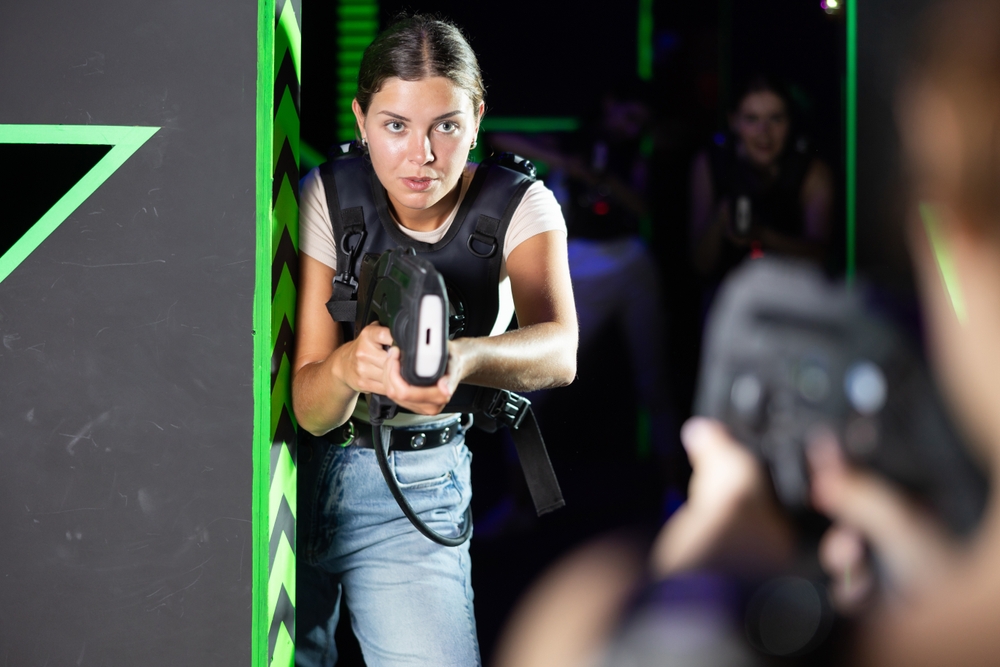
A company running its annual retreat can swap out the usual outdoor picnic for something that actually gets people moving and talking across teams instead of clustering into the same small groups they already know. A larger company running a multi-team offsite can scale the same format up without splitting into smaller groups that never interact with each other. Planners organizing large group activities for a conference can skip transporting attendees somewhere else entirely, since the whole thing sets up wherever the event already is, a hotel lawn, a company campus, or a rented outdoor space.
It also works well for companies that have already tried the standard rotation of team-building activities and found the group has aged out of trust falls and trivia nights. Something physical, a little chaotic, and genuinely fun tends to land better with a team that’s sat through one too many forced icebreakers.
1.How’s this different from a regular laser tag?
It adds water into the mix alongside the standard laser tag mechanics, which makes the whole thing feel more like play and less like a straight competition.
2.Does it actually work for big corporate groups?
Yes, that’s really the point of the on-site model. It’s built to scale past what a fixed laser tag venue can handle.
3.Can this run as an outdoor event?
Yes, it’s designed specifically as outdoor entertainment that doesn’t need a dedicated indoor space.
Team building doesn’t have to mean another awkward afternoon everyone forgets by Monday. The activities that actually work are the ones people get genuinely invested in without being told to, and that’s the gap Water Tag is built to fill, combining laser tag equipment with water into something that scales to any group size without losing the energy that makes it worth doing in the first place. For companies looking at team-building activities and wanting something people actually talk about afterward, that’s the difference worth paying attention to.
Planning team building activities that actually work is harder than it sounds. Most people have sat through the awkward trust falls, the forced icebreakers, the lunchroom trivia rounds that barely get anyone off their phones. The truth is, people remember experiences that move them, challenge them, and get them genuinely laughing with the people beside them. That is exactly the gap that Watertag fills, and it fills it better than anything else on the market right now.

There is a big difference between an activity your team tolerates and one they talk about for weeks. Real engagement happens when people are physically involved, the stakes feel real even if they are low, and every single person regardless of age or fitness level has a role to play.
Water tag hits every one of those marks. It is a structured, outdoor battle game where players wear sensor vests and use water launchers to compete across a purpose-built field of inflatable barrels. The barrels are not decorated. They serve as refill stations, defensive cover, scoring targets, and team bases all at once. That field design is what turns a simple water fight into a genuinely strategic game that requires communication, movement, and quick decision-making under pressure.
For companies, camps, resorts, and event operators looking for large group activities that scale without chaos, this format solves the two biggest problems in one shot: engagement and manageability.
Watertag, operating under the Falcon brand, was built specifically for commercial operators. This is not a consumer product that someone decided to rent out. Every component, from the vest design to the inflatable barrel system, was engineered for daily use with large groups and minimal staff overhead.
The anti-cheat vest design alone sets Watertag apart. Water enters through intake slits and collects in a lower chamber with a visible gauge. Draining it during gameplay would require an awkward, sustained tipping motion that is simply not practical in an active round. That means rounds stay fair, disputes stay minimal, and your staff spends less time mediating and more time running sessions.
Setup takes around 25 minutes. Pack-down takes about 10. The entire kit fits in a standard commercial vehicle, making it genuinely portable in a way that fixed installations or heavy laser tag equipment rigs simply are not. For operators who serve schools, corporate clients, summer camps, and resort guests, that mobility is a revenue multiplier.
Watertag also offers six distinct game modes including Team Deathmatch, Capture the Flag, Battle Royale, and Domination, giving operators enough variety to keep repeat guests fully engaged across multiple visits.
| Feature | Watertag (Falcon) | Traditional Laser Tag |
| Setup Time | 25 minutes | 1 to 3 hours |
| Portability | Fully mobile, fits a van | Fixed venue required |
| Player Capacity | 30 to 100 players per package | Usually limited by arena size |
| Age Suitability | Ages 6 and above | Varies, often indoor only |
| Staff Required | 1 manager plus 2 assistants | Larger venue staff |
| Warranty | 2 years | Typically 1 year or less |
| Game Variety | 6 structured modes | Limited by software |
| Outdoor Use | Fully designed for outdoor play | Rarely suitable outdoors |

Corporate events are one of the strongest fits. Groups that struggle to connect in meeting rooms open up completely once they are competing side by side on a battlefield. Watertag sessions give every department, every seniority level, and every personality type a common experience that flattens hierarchy in the best way possible.
Summer camps have seen some of the most enthusiastic adoption. Camp directors report that Water Tag quickly became the most requested activity of the season, appealing to children as young as seven and staff members in equal measure. On a hot afternoon, nothing else comes close.
Resorts and rental operators benefit from the recurring booking model. Because the game is genuinely replayable with six different formats, guests return for follow-up sessions rather than looking for something new. That repeat booking behavior directly improves revenue per customer across the season.
The best team building activities share one quality: people do not realize they are participating in something planned. They are just having a genuinely good time. Watertag creates exactly that experience, and it does it at a commercial scale that most outdoor entertainment options cannot match. Whether you are running corporate events, summer programs, or resort programming, Watertag gives your groups a reason to show up, stay engaged, and come back again.
The game is designed for ages 6 and above. The structured rules and physical format work across a wide range of ages without modification.
2. How many staff members does an operator need to run a session?
A single game manager and two assistants can comfortably handle up to 150 players per hour.
3. Is the water tag suitable as a corporate team-building activity?
It is one of the strongest options available. The game builds communication, strategy, and shared experience in a way that indoor activities rarely achieve.
Finding the right water park equipment suppliers is one of those decisions that looks straightforward on paper but gets complicated fast once you start comparing options. Operators running summer camps, resorts, corporate retreats, and community events need equipment that holds up under pressure, not something that performs well in a showroom and falls apart after three weekends of real use. Watertag has built its entire business model around solving that exact problem, and the results speak for themselves across hundreds of active operators worldwide.
The challenge most buyers face when sourcing commercial water park equipment is that the market mixes consumer-grade products with commercial ones, and the packaging often looks identical. A set of vests and launchers might photograph beautifully but fail structurally within a single season of daily group use.
Genuine commercial-grade equipment is built around three priorities: durability under repeated handling, fast operational turnover between sessions, and low maintenance requirements that do not demand a trained technician on site. For anyone running outdoor camp games or large-scale event programming, downtime is not just inconvenient. It directly costs revenue and damages guest trust.
Most water park equipment suppliers sell you a product and move on. Watertag operates differently. Every package purchase includes access to a dedicated operational knowledge hub, structured game formats, staffing guidance, and field layout recommendations. That post-sale support layer is what turns a purchase into a functioning attraction rather than a storage problem.
The vest system itself reflects serious engineering investment. Water enters through intake slits and settles into a lower chamber with a transparent gauge. The drainage resistance built into the design prevents score manipulation during gameplay, which matters enormously when you are running competitive sessions for corporate groups or camp tournaments.
Watertag also offers the only two-year commercial warranty in its product category. That commitment signals confidence in the product’s build quality and gives operators a real safety net when budgeting for long-term use.
| Feature | Watertag | Generic Suppliers |
| Warranty Period | 2 years commercial | Usually 6 to 12 months |
| Setup Time | 25 minutes | 1 hour or more |
| Operator Support | Full training and knowledge hub | Product manual only |
| Game Modes | 6 structured formats | None included |
| Portability | Van-friendly, no trailer needed | Often bulky or venue-fixed |
| Player Capacity | 30 to 100 per package | Fixed, rarely scalable |
| Anti-Cheat Design | Built into vest mechanics | Not available |
| Scalability | Add vests and launchers anytime | Requires full new purchase |
Company retreat activities live and die by participation rate. When people hang back or disengage, the entire event loses its purpose. Watertag’s game structure removes that problem by creating an environment where physical involvement is naturally built into the rules. Every player has a lane, a role, and a reason to move.
The web-based scoreboard tool deserves a mention here. Operators can display live results on any phone or tablet, customize team names, add company logos, and share a final recap with the client after the session ends. For corporate event planners, that kind of branded deliverable adds real perceived value and encourages repeat bookings.
The modular package structure also matters for budget planning. Operators start with 30, 60, or 100 player configurations and expand incrementally without replacing existing gear.
Outdoor camp games require activities that work across a broad age range without requiring separate setups for different groups. Watertag runs effectively from age 6 through adults, which means a single session can accommodate mixed-age groups that most activity formats struggle to serve.
For corporate event operators, the game format naturally breaks down workplace hierarchy. A senior manager and a new hire share the same field, the same rules, and the same objective. That dynamic is genuinely difficult to replicate in any structured indoor environment.
Resorts benefit from the repeat-visit model. Because six distinct game modes are included, guests who return throughout a season encounter a different experience each time. That variety is a direct driver of loyalty and positive word-of-mouth.
The difference between a good season and a great one often comes down to the quality of the equipment underneath the experience. Reliable water park equipment suppliers do not just ship boxes. They give operators the tools, knowledge, and support to build something that guests genuinely want to return to. Watertag delivers on all of those fronts, and for operators serious about growing their outdoor programming, it represents the clearest path from investment to consistent revenue.
1. What should operators take into account when evaluating providers of water park equipment?
Look for commercial-grade equipment with excellent quality manufacturing, ongoing support, a long warranty period, and good portability features, among others. You will probably discover that consumer products never meet those criteria.
2. What is Watertag’s Team Building Event?
The game is played in teams of players who wear a sensor vest and have a water launcher as their weapon of choice to score points in structured competitions on a barrel field. The structured gameplay and scoring system ensure the events are as competitive as possible and do not require any previous gaming experience to participate.
3. Are there challenges with maintaining rapid water tag equipment?
Watertag’s equipment contains virtually no electronics and uses durable components. Therefore, any routine maintenance will be simple to perform and does not require specialized training to maintain.